






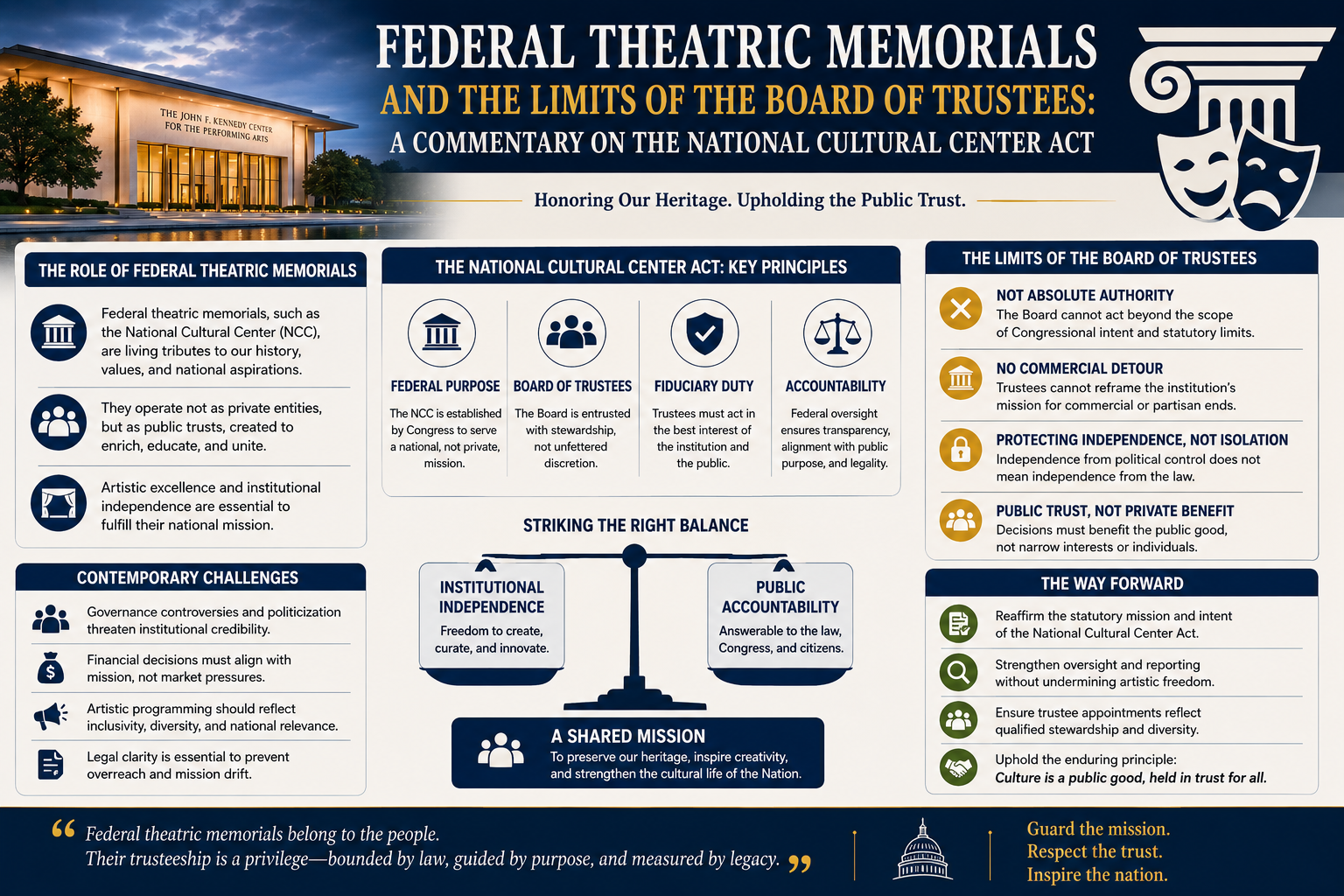
The John F. Kennedy Center for the Performing Arts is unlike any other building in the United States in that it is both a federally owned property and a "living memorial." The National Cultural Center Act, the law under which it operates and has its missionary purpose established. Under the terms of this statute, it may be guided by the action of its Board of Trustees only to the extent permitted under its constitution. In A Matter of Confidentiality and Access to Records: John Joseph Lippino v. National Cultural Center, Inc. et al. (1994), the U.S. Supreme Court held that the board was disciplined when its actions were not only inconsistent with Congress's actions regarding the Center, but also disallowed by law.
U.S. District Judge Christopher Cooper said in a sweeping May 2026 ruling that the handpicked board of directors at a public community venue had strayed too far from its fiduciary duty to protect the institution’s identity and operations. The suit stemmed from a series of controversial decisions: Renaming the venue to include Donald Trump’s name and approving an abrupt two-year total shutdown to perform “aggressive renovations.” Siding with a challenge by ex officio board member Representative Joyce Beatty, the court granted a preliminary injunction against both actions.
Board Member vs. Board: Time to Face the Music on the Justice and Accountability of Memorials-The core issues in this case involve: Identity Preservation: The organic statute makes crystal clear that the center is to be the sole national memorial to President Kennedy. Because Congress established and named the memorial, the board has no authority to unilaterally alter its name or add co-memorial designations.
Fiduciary Dereliction: The board's decision to close the center without a corresponding closure plan or public hearings on this measure was "ill-informed and seemingly preordained." The board was, in effect, operating as a duty-bearer to its patrons by opening its doors as a premier arts venue and was required, by statute, to maintain a premier arts venue.
As we have argued above, the dispute is essentially one of administration, not jurisdiction. The Kennedy Center is a federal institution, and thus Congress has the constitutional authority to determine the procedure to be used for removing the Kennedy Center Board of Trustees. By contrast, there was no such congressional authority when the Kennedy Center established the Board in 1964 and then attempted to limit its jurisdictional scope. Now the Court must again address whether the Kennedy Center is exempt from or subject to the Board’s broad authority, not whether the Kennedy Center existed or what powers the Board has. Finally, recognizing that the Kennedy Center is a federal institution.

Mukherjee Nagar, New Delhi, INDIA
+91- 8168583827 , 9810850652
globalDailyLog@gmail.com
At globaldailylog.com, Provide you all types of Information in English (or all Language By using Google text Translator), We Make Every Effort that we are Related to Computer Technology , politics , health , Corporate , Educations ,Business , Entertainment , lifestyle , foods and Travel . So If you are excited to learn something new then join our family and Increase your knowledge Power and become a big guide in yourself.So Make sure You Hit the Like Button , Share Button and Subscribe Button to Get My Latest Post. Thank you.
© GlobalDailylog. All Rights Reserved. Designed by Techknowtouchwood