


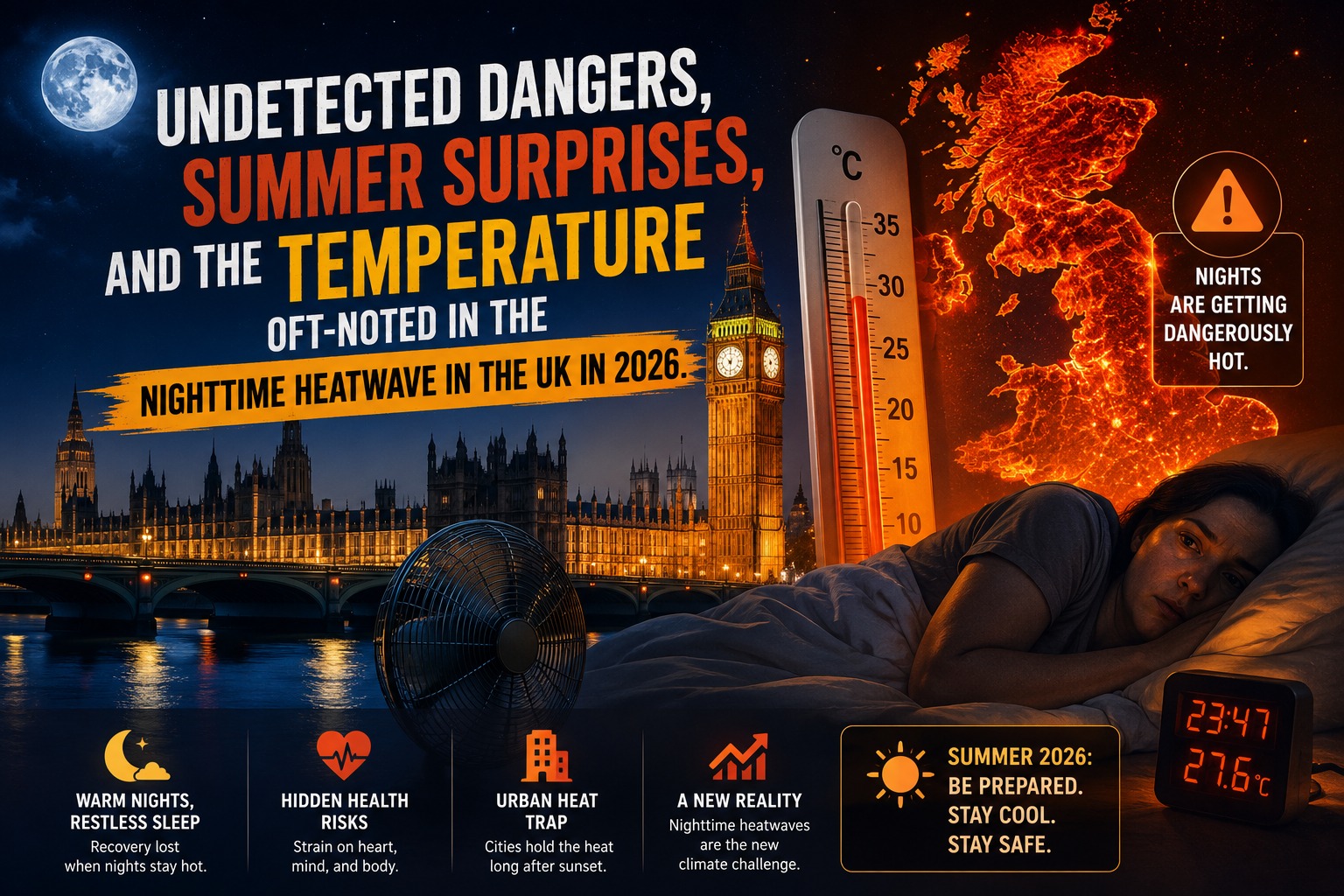





While the media, public and politicians have been inundated by eye-catching daily maximum temperatures soaring toward 38 degree Celsius, climate scientists and epidemiologists are increasingly concerned with the more insidious threat of "tropical nights" when the 24-hour period fails to dip below 20 degree Celsius, defined by the Met Office, these nocturnal high temperature windows formed a systemic threat across southern England and other urban areas during summer's historic heat waves.
It follows from physiology that, unlike ectothermic organisms, humans and other warm-blooded organisms would prefer comparatively cooler nighttime temperatures to dissipate heat accumulated during the day's work and activity. If nighttime temperatures were to remain inadequate, below 20 degrees Celsius, or close to such low temperature, the core temperature of the body would not be allowed to lower itself to a considerable amount; as a consequence, the blood would be forced to the skin at the heart's direction to dissipate body heat, consequently leading to the risky expulsion of excess water and nutrients, abandoned - for better vasculature's sake - and to the certain chances of dehydration, fatigue, or an increased likelihood of potentially morbid cardiovascular or respiratory catastrophe.
What is evident from the health effects of the heat wave is that differences heavily influence the threat to infrastructure. The UK’s domestic housing stock is largely built for heat storage rather than passive cooling. In cities, this is dramatically exacerbated by the Urban Heat Island (UHI) effect, the nuanced way in which concrete, asphalt, and the lack of greenery soak up solar radiation during the day and exude this heat back into the atmosphere at night. Thus, inner-city apartments see indoor temperatures at night and overnight far exceeding the meteorological figures we rely upon.
Epidemiological evidence associated with the UK Health
Security Agency’s (UKHSA) Amber Heat Health Alerts shows a unique lag effect:
while daytime peaks produce an immediate excess in heat exhaustion, it is the
accumulated number of consecutive tropical nights that produces an excess in
mortality, especially among 65+ citizens or those with pre-existing
conditions.
At last, studying the 2026 heat wave has shown us that night-time heat is no
longer an exotic Mediterranean condition but a near-reality for British public
health. In the future, clinical and urban architecture must represent overnight
cooling capacity not just as a comfort factor, but as a life-saving
physiological necessity.

Mukherjee Nagar, New Delhi, INDIA
+91- 8168583827 , 9810850652
globalDailyLog@gmail.com
At globaldailylog.com, Provide you all types of Information in English (or all Language By using Google text Translator), We Make Every Effort that we are Related to Computer Technology , politics , health , Corporate , Educations ,Business , Entertainment , lifestyle , foods and Travel . So If you are excited to learn something new then join our family and Increase your knowledge Power and become a big guide in yourself.So Make sure You Hit the Like Button , Share Button and Subscribe Button to Get My Latest Post. Thank you.
© GlobalDailylog. All Rights Reserved. Designed by Techknowtouchwood